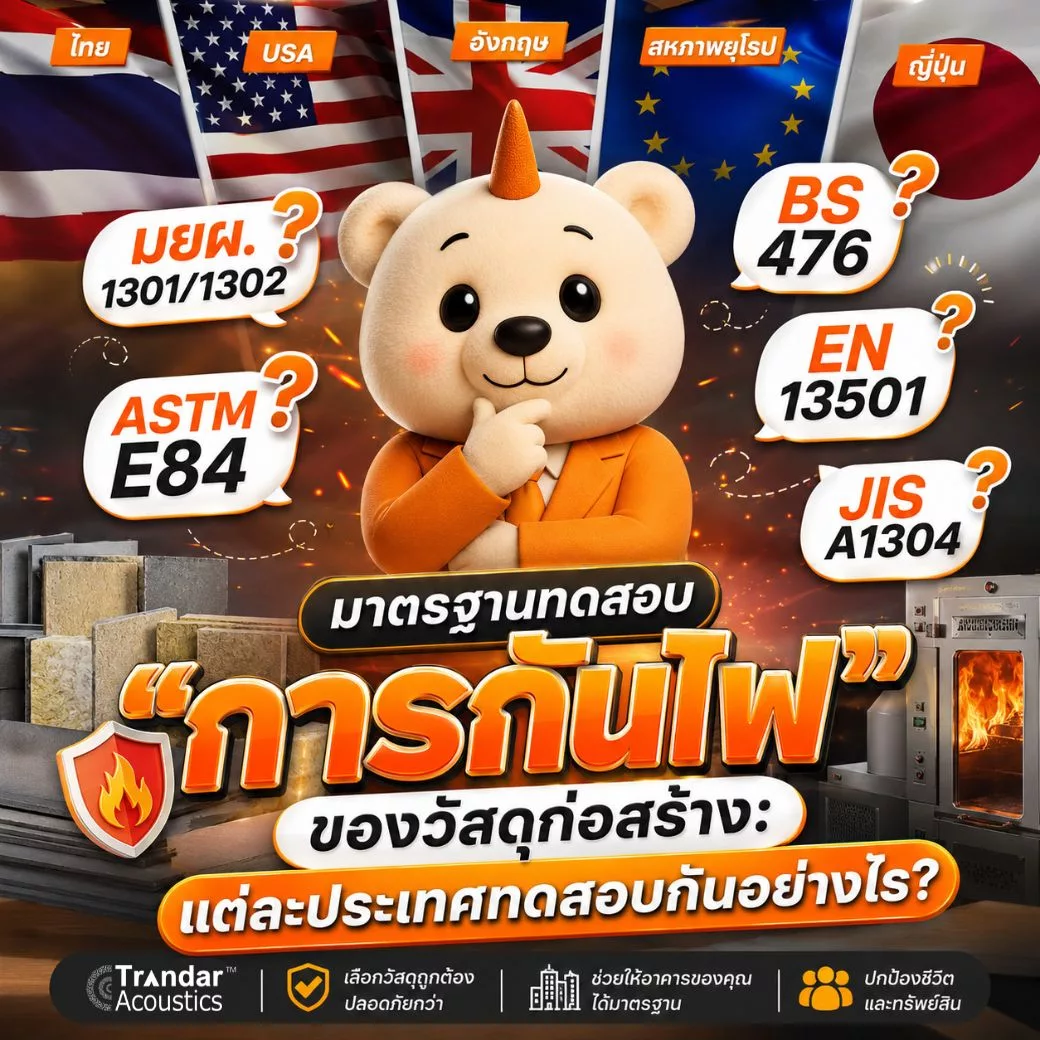
Building Material "Fire Resistance" Testing Standards
How Do Different Countries Test?
When talking about "fire-resistant materials," many people might think there is a single global standard. In reality, each country has different testing systems and grading criteria, even though they measure the same thing: "fire safety." This article introduces the main standards from 6 countries/regions referenced by architects and engineers worldwide.
First of all, it must be understood that fire-resistant material testing is divided into 3 main groups:
Reaction to Fire — Measures how easily a material ignites and how fast flames spread.
Fire Resistance — Measures how many minutes a structure (wall, ceiling, door) can withstand fire before it penetrates.
Smoke & Toxicity — Measures the amount of smoke and toxic substances produced.
🇬🇧 United Kingdom — BS 476
A long-standing standard still widely used globally, divided into several parts. The most familiar ones are:
- BS 476 Part 6-7 : Tests surface spread of flame and heat release rate, graded from Class 0 (best) to Class 4.
- BS 476 Part 20-23 : Tests the fire resistance of structures, yielding results as the duration of fire endurance (e.g., 30, 60, 90, 120 minutes) before the structure loses its ability to resist fire, heat, or smoke.
BS 476 also influences the standards of many Commonwealth countries, including parts of Thailand.
🇺🇸 United States — ASTM E84 and ASTM E119
- ASTM E84 (Steiner Tunnel Test) : Tested by igniting one end of a long test tunnel and measuring how fast fire spreads along the material surface, along with measuring smoke density (Smoke Developed Index). Results are classified as Class A (best, Flame Spread Index 0-25), Class B, and Class C.
- ASTM E119 : Tests structural fire resistance, similar to BS 476 Part 20-23, by burning a sample in a test furnace according to a standard temperature curve and measuring the duration it can withstand.
ASTM standards are popularly referenced in projects requiring high-level international standards due to their strict criteria and widespread acceptance.
🇪🇺 European Union — EN 13501
The European system stands out for providing an "easily understandable standard code" in itself.
- EN 13501-1 (Reaction to Fire) : Classifies materials into Euroclasses ranging from A1 (completely non-combustible) to F, along with supplementary codes such as s1-s3 (smoke production, s1 = lowest) and d0-d2 ( flaming droplets, d0 = no flaming droplets).
- EN 13501-2 (Fire Resistance) : Yields codes such as REI 45, meaning the structure maintains load-bearing capacity (R), integrity against fire penetration (E), and thermal insulation (I) for 45 minutes.
This system is referenced in many countries worldwide, including Asia, because it is easy to read and compare values.
🇯🇵 Japan — JIS A1304 and Building Standards Act
Japan has a long-developed testing system due to its urban history of facing major fires several times.
- JIS A1304 : Tests the fire resistance of building structural components (walls, columns, beams, floors, ceilings, roofs) using a standard temperature curve similar to ASTM E119, BS 476, and Germany's DIN 4102, making results somewhat comparable.
- Under the Building Standards Act, materials seeking certification as "Non-combustible Materials" must pass tests for both heat release and toxic gas generation according to certified agency testing manuals.
🇦🇺 Australia — AS 1530 Series
Australia uses the AS 1530 series of standards, which is divided into multiple parts similar to the British system.
- AS 1530.1 : Tests the combustibility of materials.
- AS 1530.3 : Tests ignitability, flame propagation, heat release, and smoke for internal linings during the early stages of a fire.
- AS 1530.4 : Tests structural fire resistance, yielding results as FRL (Fire Resistance Level) (e.g., 90/60/30, meaning 90 minutes structural adequacy, 60 minutes integrity, and 30 minutes insulation).
This system is directly linked to Australia's National Construction Code (NCC), and testing must be performed in NATA-accredited laboratories only.
🇹🇭 Thailand — EIT Standard 1301/1302 and Ministerial Regulations
Thailand references criteria from both international standards and specific laws.
- EIT Standard 1301 and 1302 : Specifies standards for flame spread and smoke generation of interior decoration materials in public buildings, requiring corridors and evacuation routes to meet the highest safety standards equivalent to Class A (FSI 0-25 and SDI not exceeding 450 according to the ASTM E84 system).
- Ministerial Regulations related to building safety : Stipulate that materials used for ceilings, walls, and interior decoration must be flame-retardant and strictly certified for fire and smoke propagation, especially in public service areas.
Why This Matters When Choosing Materials
Although the standard names differ, the basic principles are similar:
(1) How slowly the material spreads flames
(2) How many minutes it can withstand fire
(3) How much toxic smoke is produced
Architects and designers working on international projects therefore often need to understand more than one system to select materials suitable for each country's requirements.
Trandar Acoustics products have been tested and certified to cover multiple international standards (such as BS 476, ASTM E84, EN 13501) to ensure they can be referenced for both domestic projects and projects requiring overseas standards.




 ไทย
ไทย
 中文
中文
 日本語
日本語
 한국어
한국어
 English


